WellChat.
Turning a health plan website that people bounce off into answers they can act on.
Marketing Consultant · Research, strategy and prototyping

The problem
Members had questions. The website had a maze.
WellSense wanted to lift the rating of its Qualified Health Plans, and a large part of that rating comes down to one thing: can members find what they need? Costs of services, equipment and prescriptions, forms, in-network providers, insurance terms. The information existed. The paths to it did not.
1m 4s
Average engagement time across 567K sessions
50%
Bounce rate on the website
25%
Of all support calls were about benefits
Confusing navigation did more than frustrate people. It pushed them to the phone, and every one of those calls was a question the website could have answered.
What members told us
People want the official site to work. It just doesn't.
“Insurance websites are like an unorganized dictionary that I need to dig through by myself.”
Only 34% of people prefer getting health insurance information from the company's own website. The rest go around it. We surveyed members on what a better path would need to do, and two needs stood out above everything else.
What a chatbot must help with
Chatbot features members value
Choosing what to build
Four ideas, weighed on impact against effort.
We proposed a printed fridge magnet, an FAQ hub, video tutorials and a chatbot. The chatbot and video tutorials carried the most impact, so both went into concept testing.
61%
Would switch from customer service to a chatbot
51%
Would switch from customer service to videos
The chatbot won on the metric that mattered most: pulling people away from the call center. Then came the real question, which kind of chatbot?
| FAQ guide | Smart chatbot | |
|---|---|---|
| Scope | A handful of predetermined questions | A wide variety of member inquiries |
| Answers | Links to existing webpages | Direct answers in the chat |
| Input | Menu-based buttons | Open-ended text and buttons |
| Cost | About $119 a month | $7K to $20K up front, then $100 to $2K a month |
The tradeoff
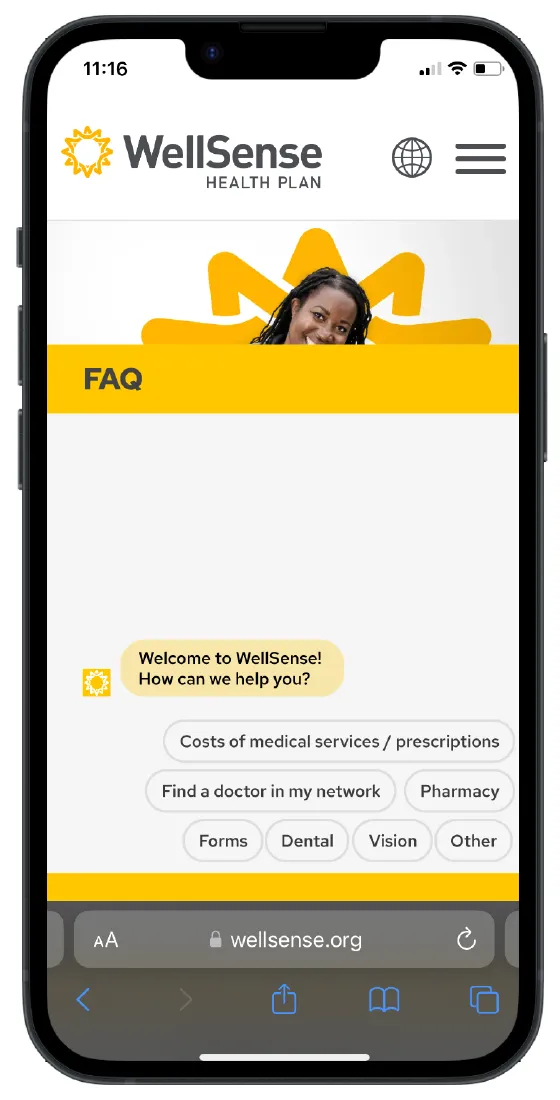
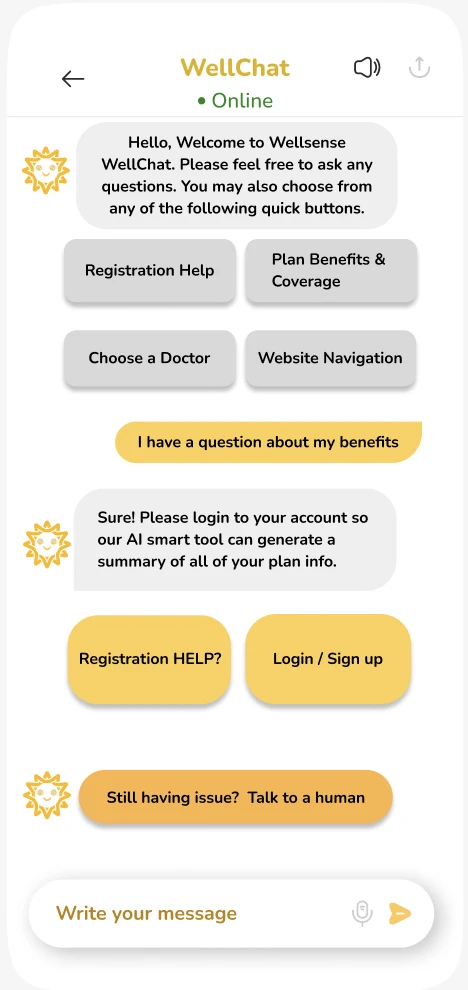
A menu-based guide is cheap and fast to test, but it can only point. An open-ended chatbot can actually answer, but it costs more and has to clear HIPAA and data-privacy review. Rather than pick one, we prototyped both, so WellSense could start small and upgrade with evidence.
Two prototypes
One to test the waters. One to answer everything.
Weighing a menu bot against an open-ended assistant for your own members?
Let's talkMaking the case
The chatbot earns its cost by removing three pains.
- Confusion about registrationBecomes a guided path, with a video when text is not enough.
- Information that is hard to find on the websiteBecomes a direct answer, not a link to dig through.
- Long call center wait timesBecomes fewer calls, because the easy questions never reach the phone.
Two more things tipped the scales. Neighbouring plans such as Tufts Health Plan and Blue Cross Blue Shield had no chatbot at the time, so this was a chance to lead. And a self-learning assistant keeps getting better at the problems members have not hit yet.
| In-house smart chatbot | Estimated cost |
|---|---|
| Design | $1,000 to $2,000 |
| Development | $5,000 to $15,000 |
| Testing | $1,000 to $2,500 |
| Platform | $50 to $300 a month |
| Support and maintenance | $50 to $2,000 a month |
Compliance first
Health data raised the bar for every design choice. Public information could be answered openly; anything tied to a member, such as a plan summary, sat behind login and was scoped for HIPAA and data-privacy review before build.
Impact and measurement
A case for self-service, with the KPIs to prove it.
61%
Of members ready to move from calls to chat
2
Prototypes, from a $119 test to a full assistant
3
KPI families: ratings, call load and website usage
| Measure | What to track |
|---|---|
| Ratings | Ease of finding information, chatbot satisfaction score |
| Customer service | Number of calls, share of calls about website-solvable questions |
| Website | Number of visits, bounce rate |
Better answers lift plan ratings, which drives enrollment. Fewer avoidable calls cut service costs. And a website that answers the first time builds the trust a health plan runs on.
What this changed about how I work
Start from the member's question, not the org chart. Most of the fix was not the technology; it was noticing that a quarter of the call volume was the website failing quietly, and giving the business a cheap way to prove that before spending on the expensive answer.
Have a support queue full of questions your website should answer?